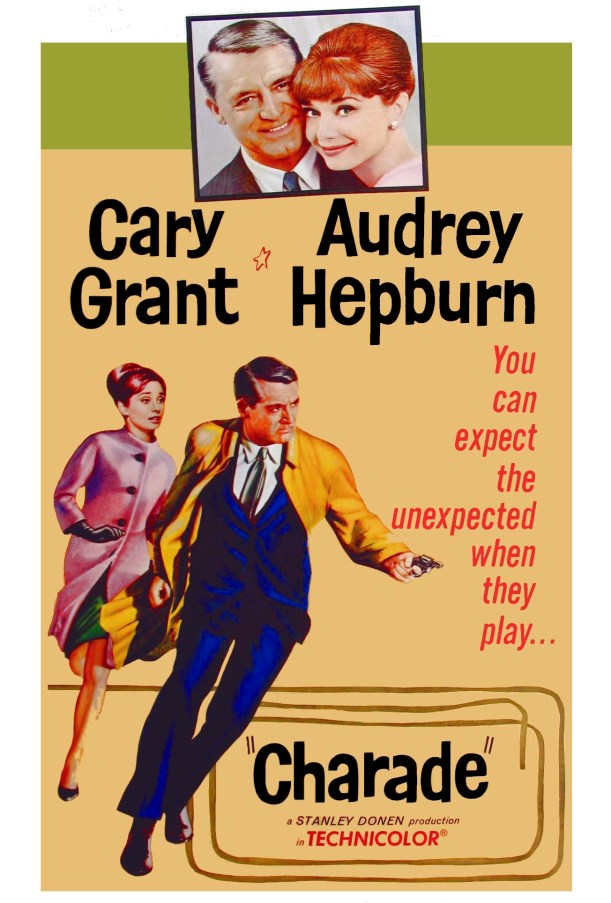
Watch This Classic Romantic Comedy/Thriller for Free on Valentine’s Day!
Charade is a 1963 Technicolor American romantic comedy/mystery film directed by Stanley Donen, written by Peter Stone and Marc Behm, and starring Cary Grant and Audrey Hepburn.

Charade is a 1963 Technicolor American romantic comedy/mystery film directed by Stanley Donen, written by Peter Stone and Marc Behm, and starring Cary Grant and Audrey Hepburn.
In 1928, young Martha Ivers is returned by the police to Iverstown, Pennsylvania after running away for the fourth time to escape the tyranny of her aunt. When her aunt insults her dead father, then attacks her pet cat with a cane, the child kills her aunt with the cane. Martha’s friend, Sam Masterson, with whom she was trying to run away, flees the scene and joins the circus. Mr. O’Neill, Martha’s greedy tutor, and his weak-minded son Walter, support Martha’s story that the murderer was a strange intruder. In 1946, Sam inadvertently returns to Iverstown when he wrecks his car. He meets Toni Maraceck, who was let out on parole that night on a theft charge of which she is innocent. Walter, now a dipsomaniacal district attorney, is running for political office at the urging of Martha, who is now his wife and runs the family mill, which she has built into a considerable fortune. Although Walter loves Martha, they have a passionless marriage because she has never stopped loving Sam. When Toni is picked up by the police for violating her parole, Sam goes to Walter’s office and appeals to him for help, and Walter assumes that Sam is in town to blackmail him and Martha. When Martha enters, Sam realizes she and Walter are married. He later visits Martha at the Ivers home, where she confesses her love for him. Walter forces Toni to make a deal with him or be sent back to prison, and she sets Sam up, unaware that Walter’s men are going to beat him. Sam awakens from the assault to find himself in a ditch. He then confronts Walter, who accuses him of blackmail.

The Strange Love of Martha Ivers
Sam investigates Martha’s aunt’s death in archival newspapers and learns that the case had remained unsolved for years until a man who used to work for the Ivers family was picked up on a small holdup charge and accused of the murder. Walter, who was engaged to Martha at the time, handled the prosecution of the man. Armed with new information, Sam demands half-ownership in Martha’s factory. She later takes him for a drive, and at a hillside campfire, inadvertently confesses to the murder, unaware that Sam never knew. Terrified that Sam will use her confession against her, Martha tries to burn him with an ember, but he kisses her, turning her rage into passion. She then blames Walter for sending an innocent man to die. Later, a drunken Walter orders Sam to the Ivers house and claims that it was Martha’s idea to hang an innocent man. Sick with the knowledge of what they have become, Walter begs Martha for help, then falls down the stairs. Martha tries to seduce Sam into killing Walter while he is knocked out, but Sam gently carries Walter to a chair. Although she pulls a gun on Sam, he walks out. As Martha and Walter watch Sam from the window, he tells her she will always love Sam, but she swears that now she loves only Walter. Walter then presses the gun into Martha’s ribs, and she puts her hand on his, and together they pull the trigger. Walter then shoots himself. Toni and Sam drive out of town, planning to marry and vowing to never look back.
Source: TCM
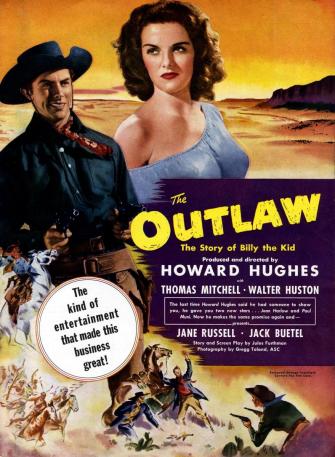
Download “The Outlaw”
Although the youth, William Bonney, an infamous gunslinger known as Billy the Kid, maintains that he bought Red from a stranger, Doc insists that he stole him.
Shortly after he disembarks at the Lincoln, New Mexico train depot, gun-slinging gambler Doc Holliday reunites with his old friend and former partner-in-crime, Pat Garrett. When Pat, who is now the town’s sheriff, hears that the penniless Doc is searching for his horse Red, who has been stolen, he directs his friend to the local dentist’s office. There Doc finds Red tied up outside and confronts the young man who comes to claim the horse. Although the youth, William Bonney, an infamous gunslinger known as Billy the Kid, maintains that he bought Red from a stranger, Doc insists that he stole him. Despite their disagreement, Doc takes Billy’s side when Pat tries to arrest him for theft. Annoyed, Pat orders Doc and the smooth-talking, quick-fisted Billy to leave town by sundown. Doc and Billy, however, ignore Pat’s command and play cards together in the cantina. Doc wins hand after hand from Billy and is unruffled when his rival accuses him of cheating. After Doc announces he is giving Red to Billy as a gift, however, he tries to sneak the horse out of the barn, but is caught in the act by a watchful Billy. Moments later, as Billy is about to settle down next to Red, he is shot at by an unseen assailant. In the darkness of the barn, Billy overpowers his attacker, who turns out to be a beautiful woman named Rio McDonald. While struggling to free herself, Rio condemns Billy for murdering her brother and vows to kill him. Billy admits to shooting Rio’s brother in a fight over a woman, but insists that the match was fair and gives Rio a passionate kiss. The next morning, in the cantina, Billy is approached by a stranger who identifies himself only as an enemy of Pat. The stranger enlists Billy’s help in confronting Pat and suggests they stage a mock fight as practice. Suddenly sensing a set-up, Billy draws his guns one second before the stranger does and kills him. After they learn that the stranger was actually a friend of Pat, Doc advises Billy to flee, but Billy insists on facing the sheriff.

The Outlaw
Maintaining that he was pushed into the gunfight, Billy refuses to give himself up to Pat and his deputies, and is shot by Pat. Before Pat can fire his rifle again, Doc shoots the gun out of his hand and downs two of his deputies. As Doc and a wounded Billy are about to leave the cantina, Pat angrily declares his friendship with Doc “finished.” Doc takes Billy to recuperate at Rio’s house, unaware that Rio, his girl friend, had previously tried to kill Billy. After Doc leaves, Rio contemplates stabbing the unconscious Billy, but is unable to do the deed. Instead, Rio and her aunt Guadalupe nurse Billy through fever and chills until, one month later, he is recovered. Rio admits to Billy that she is Doc’s “girl,” but gives in to his seductive charm and kisses him. Soon after, Doc returns and learns that Rio married Billy during one of his delirious periods but has not told him about their new relationship. Although Doc is angered by Rio’s change of heart, he is more infuriated by Billy’s continued insistence that Red is his horse. To resolve the matter, Billy offers Doc a choice between Red and Rio. Doc quickly picks Red over Rio, and the two men ride off toward the desert together. When they see Pat approaching in the distance, they deduce that Rio revealed their route and then discover that she filled their canteens with sand. After a thirsty night, Doc wakes to find Billy gone and Pat at his side. Pat arrests Doc, while Billy sneaks into Rio’s house and takes her by surprise. Later, on the trail, Doc and Pat find Rio tied between two rocks, abandoned with no water. Confident that Billy will return to free Rio, Doc and Pat lie in wait for him. As predicted, Billy shows up the next morning and is apprehended. While Doc and Billy argue about whether Billy is in love with Rio, a hostile Indian group sends smoke signals announcing the white men’s presence. Pat, Billy and Doc jump on their horses and head for nearby Fort Sumner, but are soon overtaken by the Indians. Reluctantly, Pat 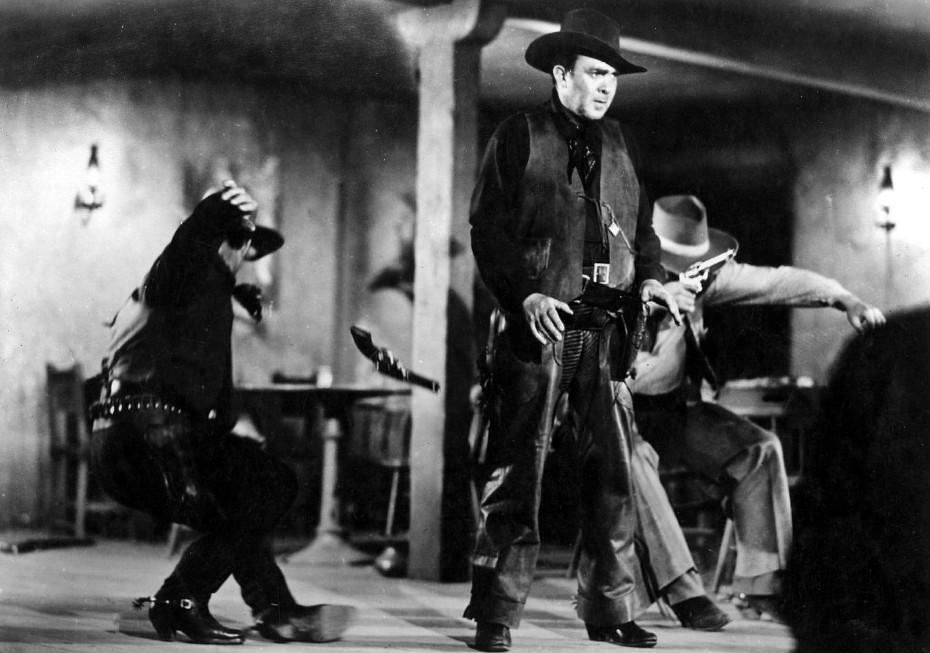 gives Billy and Doc guns, and the three men charge madly for the fort, chased closely by the Indians. By dragging cacti behind them, the men create a moving dust storm, which causes the Indians to give up their pursuit. While the men stop at a house to rest, Pat gives owner Pablo a note to deliver to the Fort Sumner marshal. Overhearing Pat and Pablo’s conversation, Doc is about to flee on Red when he is stopped by Billy, who insists once more that the horse belongs to him. Billy challenges Doc to a duel over Red, and although Billy outdraws Doc, he is unable to shoot him. Annoyed by Billy’s sudden passivity, Doc shoots the youth’s hand and then his earlobes. Stating that Doc is the only partner he has ever had, Billy refuses to fight back, however, and the two men finally reconcile. Humiliated by Doc’s obvious preference for Billy, Pat explodes with anger and shoots Doc. The next morning, after a remorseful Pat and Billy bury their friend, Pat allows Billy to leave. As he is about to ride off, Billy invites Rio to join him, and Rio happily accepts.
Source: TCM

Click to Get: Vivaldi – The Four Seasons
The Four Seasons (Italian: Le quattro stagioni) is a set of four violin concertos by Antonio Vivaldi. Composed in 1723, The Four Seasons is Vivaldi’s best-known work, and is among the most popular pieces of Baroque music. The texture of each concerto is varied, each resembling its respective season. For example, “Winter” is peppered with silvery pizzicato notes from the high strings, calling to mind icy rain, whereas “Summer” evokes a thunderstorm in its final movement, which is why the movement is often dubbed “Storm.”
The concertos were first published in 1725 as part of a set of twelve concerti, Vivaldi’s Op. 8, entitled Il cimento dell’armonia e dell’inventione (The Contest between Harmony and Invention). The first four concertos were designated Le quattro stagioni, each being named after a season. Each one is in three movements, with a slow movement between two faster ones. At the time of writing The Four Seasons, the modern solo form of the concerto had not yet been defined (typically a solo instrument and accompanying orchestra). Vivaldi’s original arrangement for solo violin with string quartet and basso continuo helped to define the form.
source: Wikipedia

Patriots: Super Bowl XLIX Champions Wallpaper – Click Here to Get it!

Click Here for Super Bowl XLIX – HD Wallpaper

Download or Stream
After two Oregon newlyweds are robbed and murdered in their car by a hitchhiker, police release a photograph of their prime suspect, ex-convict Emmett Myers. The hitchhiker then kills and robs a salesman in central California. Soon after, two Arizona men, draughtsman Gilbert Bowen and garage owner Roy Collins, drive across the California-Mexico border on their way to a fishing vacation in Baja. Once past Mexicali, Roy and Gil offer a lift to a stranded stranger. Almost immediately, the man, Myers, pulls out a gun and forces them to stop on a side road. Myers, who freely admits his identity, confiscates Gil’s rifle and ammunition, then orders them back on the highway. After warning Roy and Gil not to “get smart” like his previous victims, the excitable Myers demands to know when their wives expect them home. To keep Myers calm, Roy responds that they are not due back anytime soon. Later, while stopped for gas, Gil starts conversing in Spanish with the non-English speaking attendant, and Myers, who does not understand Spanish, flashes his gun at Gil to keep him quiet. At the next deserted side road, Myers studies a map and decides he is going to catch a ferry in Santa Rosalia, 500 miles away. Myers then shows off his shooting skills and forces Gil to fire his rifle at a tin can that Roy is holding hundreds of feet away. Gil’s shot hits the can, but both men are shaken by the incident. Pushing on, Continue reading
The Great Train Robbery
The Great Train Robbery is a 1903 American silent short Western film written, produced, and directed by Edwin S. Porter. At ten minutes long, it is considered a milestone in film making, expanding on Porter’s previous work Life of an American Fireman. The film used a number of innovative techniques including composite editing, camera movement and on location shooting. The film is one of the earliest to use the technique of cross cutting, in which two scenes appear to occur simultaneously but in different locations. Some prints were also hand colored in certain scenes. However, none of these techniques were original to The Great Train Robbery, and it is now considered that it was heavily influenced by Frank Mottershaw’s earlier British film A Daring Daylight Burglary.
Source: IMDB




 WeaveStream